
How the MLS works
Who Holds the Mandate? The Question Nobody Can Answer
Ask four agents who has the owner's instruction and you get four different shrugs. Why the question is unanswerable, and what has to change for it not to be.
Ask the simplest question in Nigerian property and watch what happens.
Who has the owner’s instruction to sell this?
The agent who sent you the listing will say they are working on it. The one who sent it to them will say the same. Somewhere four forwards back there is a person who actually spoke to the owner, and nobody between you and them can name who that is.
Nobody is lying. That is what makes it interesting.
Why the Question Has No Answer
A property enters the market as an instruction from an owner to one agent. Then it is forwarded, because forwarding is how an agent with no inventory this month gets to be in a deal at all.
At the first forward, the information is still intact. By the third, what travels is a set of photographs, a price and an area. The authority behind it does not travel, because nothing carries it.
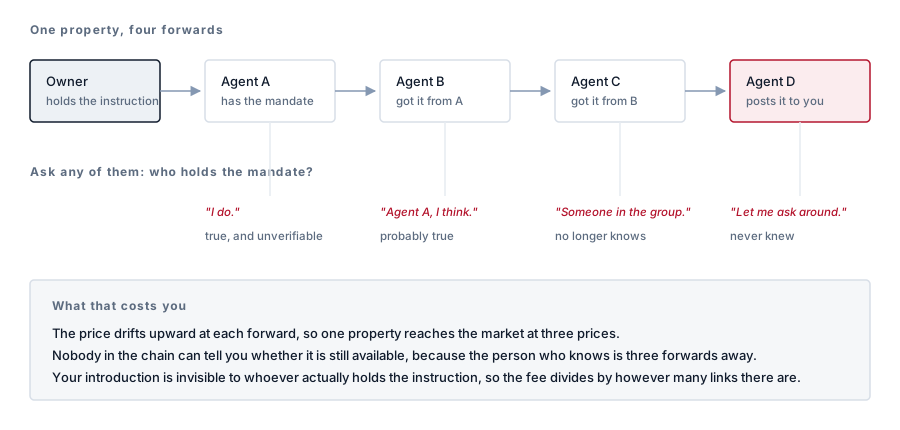
Each link can answer a different question from the one you asked.
So by the time a listing reaches you, “who holds the mandate” is not a question anybody is refusing to answer. It is a question the chain has lost the ability to answer. The last person who knew is several forwards upstream and may not remember either.
What It Costs, Beyond the Annoyance
Three things, and only the first is obvious.
The price stops meaning anything. Each link adds margin, which is how one property reaches the market at three prices. A buyer who checks two sources finds two numbers and concludes the market is dishonest, which is a reasonable conclusion from the evidence.
Nobody can tell you if it is still available. The person who would know is not in the conversation. So a property that sold in June is still being sent around in September, and every agent forwarding it is being embarrassed by information they had no way to check.
Your introduction disappears. You bring the buyer. The fee divides by however many links are between you and the owner, and the person who actually holds the instruction has no idea you exist. That is the half of co-broking that nobody advertises.
The Person Losing Most Is the One Who Has It
Everything above is written from the buyer’s side. Turn it around, because the agent who actually holds the instruction is worse off than anybody.
Their property is circulating at prices they did not set. A buyer arrives quoting a figure two million above what the owner agreed, and the conversation starts with the agent explaining why the number is wrong, which sounds exactly like a man dropping his price under pressure.
They cannot tell who is marketing it. Not out of secrecy, simply because there is no list. So when a buyer says they saw it somewhere, the honest answer is that it could have been any of a dozen people.
And when the owner asks how the marketing is going, they cannot answer that either. They can describe their own effort. They cannot describe what has happened to the property, because most of what has happened to it happened out of their sight.
That is the case for recording authority that has nothing to do with policing anybody. Where nothing records who holds an instruction, holding one is worth less than it should be: there is no way to demonstrate it and no way to benefit from it.
The Word People Reach For, and Why It Does Not Help
“Exclusive” is doing enormous work in Nigerian property and carrying almost none of it.
An agent says they have an exclusive mandate. They may have a signed agreement with the owner. They may have a WhatsApp message saying go ahead. They may have met the owner’s brother. All three get described the same way, and a buyer has no way to tell them apart.
This is the same failure as a verified badge that does not say what was checked. A single word covering several different claims stops being information and becomes decoration, and the honest agent loses most, because the word they earned is being spent by somebody else.
What Has to Change for the Question to Be Answerable
Not trust. Not a code of conduct. Something duller: the authority has to be recorded when the listing is created, and it has to be recorded as one of a fixed set of things rather than as prose.
That is the mechanism a listing service can actually provide. Putting a property on the record means declaring what right you are marketing it under, chosen from a short list: an exclusive mandate, owner authorisation, developer authorisation, a non-exclusive arrangement, or none at all.
Two details in that list matter more than they look.
The list is closed. Five values, not a text box. A text box would fill with “working on it” and we would be back where we started.
One of the five is “no mandate”. An agent can say, on the record, that they are forwarding something they have no instruction on. That sounds like an admission nobody would make. It is the opposite: it is the only honest option for most of a forwarding chain, and making it available is what stops everyone else quietly claiming more than they have.
When Two People Claim the Same Property
Because they will.
A claim is not an argument in a group chat, and it is not a platform picking a side. It is a formal process with evidence attached, a deadline for the other party to respond, and a record of what each side submitted. Either a mandate document is produced or it is not, and the outcome is recorded either way.
The point is not that a platform can adjudicate a mandate. It is that the question stops being unanswerable. Somebody can be asked, and the asking leaves a trail.
What This Does Not Fix
Being direct about the limits, because this is a piece about a claim nobody can verify.
A declaration is not a document. An agent who declares an exclusive mandate is making a statement that can be challenged, not producing a signed agreement. The value is that the statement exists, is specific, and is attached to their name.
Old listings predate the rule. Any requirement introduced at a point in time applies to what is created after it. A market’s back catalogue is always messier than its current intake, and anyone who tells you otherwise has not looked.
It says nothing about the title. Authority to market and soundness of ownership are different questions with different answers, and the checks that protect your money are the ones you commission yourself. Valuation is a third question again, and Nigeria has a professional body whose members do that work.
The Question to Ask Anyway
Whether or not anything is on a record, ask it. Not “do you have the mandate”, which invites a yes.
Ask: who spoke to the owner, and can you reach them today?
It is a better question because it is checkable. An agent with a genuine instruction can answer in one sentence. An agent three forwards down the chain will tell you they will find out, and now you both know where you stand, which is more than you knew a minute ago.
If they say they are also co-broking, that is not the problem. Not knowing is.
Why This Is Worth Fixing
A market where the source of a listing cannot be established prices that uncertainty into everything. Buyers discount every claim because some claims are false. Honest agents carry the cost of dishonest ones. And the whole thing runs on relationships because relationships are the only verification available.
That is not a moral failing. It is what happens when there is no shared record, and it is what a listing service exists to change. None of it is peculiar to Nigeria either: establishing who may market a property is part of what a listing service does wherever one works.
If you want to see how the record handles it, look at how a listing works, or ask us directly what is and is not established when a property goes on.
Listen to this article
Read aloud by your device’s voice.