
Working the pipeline
Why Your WhatsApp Leads Go Cold, and the Hour That Decides It
A WhatsApp enquiry is not lost because you ignored it. It is lost because nothing outside your head remembers it. What the first hour changes, and why.
She messaged at 9:14 on a Tuesday. “Good morning sir, is the 3 bedroom in Gbagada still available?” You saw it, you were driving, you meant to reply properly rather than fire off a one-word answer.
By the time you looked again it was Thursday, and there were sixty messages between hers and the bottom of the list.
You did not ignore her. You lost her, which is a different thing and has a different fix.
The Hour Is Real, and It Is Not About Being Fast
There is a widely repeated claim that a lead contacted within five minutes is vastly more likely to convert than one contacted an hour later. It traces back to one study of American firms published in 2011, and the specific multiplier deserves suspicion: different market, different decade, mostly business software rather than property.
What survives translation is duller and more useful. A person who sends an enquiry is, at that moment, actively looking. They have almost certainly messaged more than one agent. The first substantive reply gets to define the conversation, and every later reply is compared to it.
So the hour matters, but not because speed is a virtue. It matters because it is the only window where you are the one shaping the question rather than answering somebody else’s.
The Real Reason It Goes Cold
Here is the part most advice gets wrong. It tells you to reply faster, which is advice you have already thought of and already cannot follow.
The enquiry did not die because you were slow. It died because the only record of it was a chat thread that keeps moving, and a memory that was busy.
Think about what a WhatsApp message actually is as a business record. It has no status. It has no owner when three people share the phone. It has no date it is supposed to come back to you. It cannot be sorted by whether anybody answered. And it is buried by the next twenty messages, which are from suppliers, colleagues and your cousin.
The problem is not the channel. WhatsApp is where Nigerian property actually happens, and telling an agent to stop using it is advice from somebody who has never tried to sell a flat in Lagos. Its own business product is built for conversations, and it is good at them. The problem is that a chat thread is a conversation and a pipeline is a list, and trying to run a list inside a conversation is what fails.
Which means the fix is not to abandon the channel. It is to make the channel write things down.
What You Actually Do in the First Hour
Four things, and only the first is urgent.
Answer the question she asked. Not a brochure, not a call request. If the Gbagada flat is gone, say it is gone and name one thing close to it. An agent who answers the literal question is rare enough to be memorable.
Get one fact you did not have. Her budget, her timeline, whether she has seen the area, whether somebody else is deciding with her. One fact, asked as a question a person would ask.
Write it down somewhere that is not the chat. This is the step that decides whether she is still a lead next week.
Set the next contact before you close the app. Not “I will follow up”. A date.
The first three take four minutes. The fourth takes ten seconds and is the one almost nobody does.
Why Writing It Down Is the Whole Trick
An enquiry that exists only in a chat thread has to be remembered to survive. An enquiry written down survives being forgotten, which is the realistic case.
That is the difference between a busy agent who loses half their pipeline and a busy agent who does not. Both forget. Only one has something that remembers on their behalf.
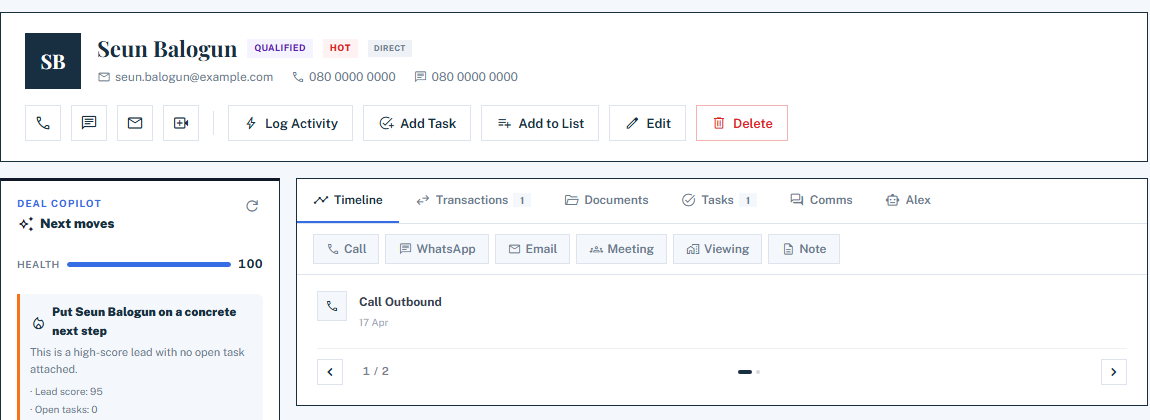
One person, every time they have ever contacted you, in order. Shown on demonstration data.
What It Looks Like When the Channel Records Itself
Worth being precise about here rather than vague and impressive, because this is the part a reader will check.
A message arriving on a connected WhatsApp number is matched to a person. If that number has contacted you before, it joins the record you already have. If it has not, a new one is created. Either way there is now something outside the chat that knows she asked.
Then the assistant answers. Not with an acknowledgement, with a reply to the question she actually sent, and it asks the one thing you would have asked. The reply is paced rather than instant, deliberately, because a response that lands in the same second as the message announces itself as a machine and she is already talking to three humans.
Two limits worth stating plainly. Anyone can stop it with a single word, and that is the end of it for them. And it only engages leads that arrive through a real inbound channel, not the ones an agent typed in by hand, because a contact you entered yourself does not want an introduction from a stranger.
None of that replaces you. What it does is carry the enquiry across the gap between her message and your attention, which is the gap most of them are lost in.
The Returning Enquiry Nobody Recognises
Now the failure that costs the most, and it is invisible while it happens.
She comes back in March. Different number, maybe, or the same number and a different agent picks it up. To whoever answers, she is a brand new enquiry about a brand new property.
Except she is not. She asked in January, she was not ready, her husband said wait. Someone in your office already knows her budget and already knows she hated the last place because of the access road. None of that reaches the person typing the reply, so she gets treated like a stranger and answers the same three questions again.
She notices. People always notice.
This is why a lead is a person rather than an enquiry, and why a repeat contact should enrich what you already know instead of creating a second record of the same human being. A returning buyer is the warmest lead you will get all month, and the ordinary way of working turns them into the coldest.
What This Has to Do With Your Listings
A slower answer than it looks.
Half of what makes a first reply good is knowing whether the property is still available, and at what price, without ringing anybody. If your inventory lives in a group chat, you cannot answer her question in the first hour because you do not know the answer yourself. You are waiting on somebody else to confirm what you are selling.
That is the same problem as one property appearing at three different prices, seen from the agent’s side instead of the buyer’s. When there is one record and it is current, the first reply is easy. When there is not, the first hour is spent finding out rather than selling, which is the record problem doing its usual damage.
What Not to Do
Do not buy an autoresponder and call it solved. A message that says “Thanks for contacting us, an agent will be in touch” is worse than silence. It tells her she has reached a system, and she is already talking to three humans.
That is a different thing from what is described above, and the difference is the whole point. An autoresponder acknowledges. It answers nothing, records nothing, and asks nothing. If the reply does not move the conversation forward and leave a record behind, it is decoration with a delivery receipt.
Do not move the conversation off WhatsApp to prove you are professional. Meet her where she is. Record it where you work.
Do not confuse a fast reply with a good one. A three-second “Yes available” to a property that sold in July does more damage than a two-hour reply that is true.
The Honest Limit
None of this manufactures buyers. If your enquiry volume is low, better handling of it will not fix that, and you should read getting leads without paying for ads instead, because that is the different problem with different answers.
What this fixes is the gap between the enquiries you already get and the ones you actually convert. For most agencies that gap is wider than their marketing problem, and it is cheaper to close.
What To Do This Week
Scroll back through your WhatsApp to the beginning of last month. Count the enquiries nobody replied to. Not the ones that went nowhere, the ones that got no answer at all.
That number is the argument. It is usually higher than anyone expects, and it is made entirely of people who wanted to give you money.
Then pick the five most recent and answer them, late. Some will be gone. One will not be, and she will be surprised anybody came back at all.
If you want to talk through how to get your enquiries out of a chat thread and into something that remembers them, tell us what you are dealing with, or see how the record works if the harder half of your problem is not knowing what you are selling.
Listen to this article
Read aloud by your device’s voice.